Get ready for your license test with AI assistance!
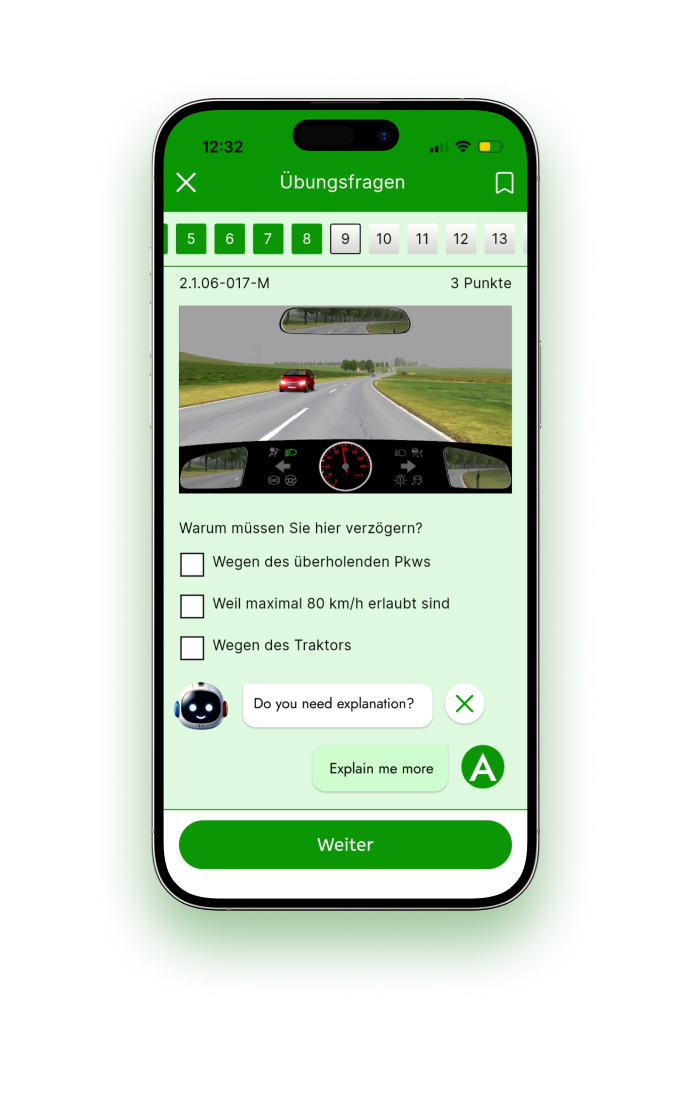
What should you anticipate now?
The driver of the [yellow] vehicle opens the driver-side door
The [blue] truck pulls out to the left
[The cyclist] pulls out to the left
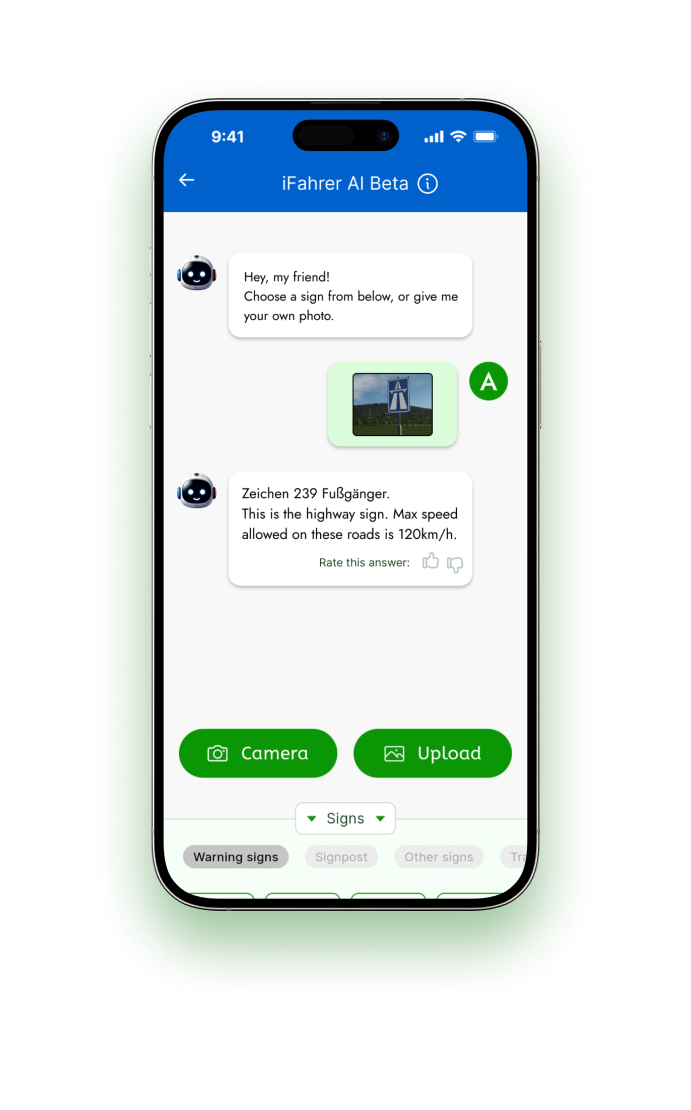
Here is Our AI Assistant's Explanation
Here all three anticipations are correct because you are approaching a typical “bottleneck” situation: a stopped/parked vehicle on your side and vulnerable road users nearby. In German theory questions, you should always expect several hazards at once, not just the most obvious one.
Answer 1 (the driver opens the door) is something you must anticipate whenever you pass a stopped/parked vehicle. A door can swing into your lane suddenly (“dooring”). Rule of thumb: slow down, keep enough lateral distance if possible, and be ready to brake.
Answer 2 (the truck pulls out to the left) is also a classic risk when a vehicle is stopped or moving slowly at the curb. To get around an obstacle or to re-enter traffic, drivers often steer left into the lane. They might not signal early or might misjudge your speed. So you should create space and avoid overtaking aggressively.
Answer 3 (the cyclist pulls out to the left) is very likely because a cyclist riding along the right edge must move left to pass the stopped vehicle safely. German rules require you to show special consideration for vulnerable road users (§1 StVO) and, when overtaking cyclists, to keep at least 1.5 m in town (2 m outside town). Practically, that means you often need to slow down and wait until you can pass with enough space, because the cyclist may have to enter your lane.
How to solve similar questions: if you see a stopped vehicle near the curb plus a cyclist, assume “door opens” + “vehicle pulls out” + “cyclist moves out.” Your response is usually early speed reduction, increased attention, and readiness to brake rather than trying to squeeze through.